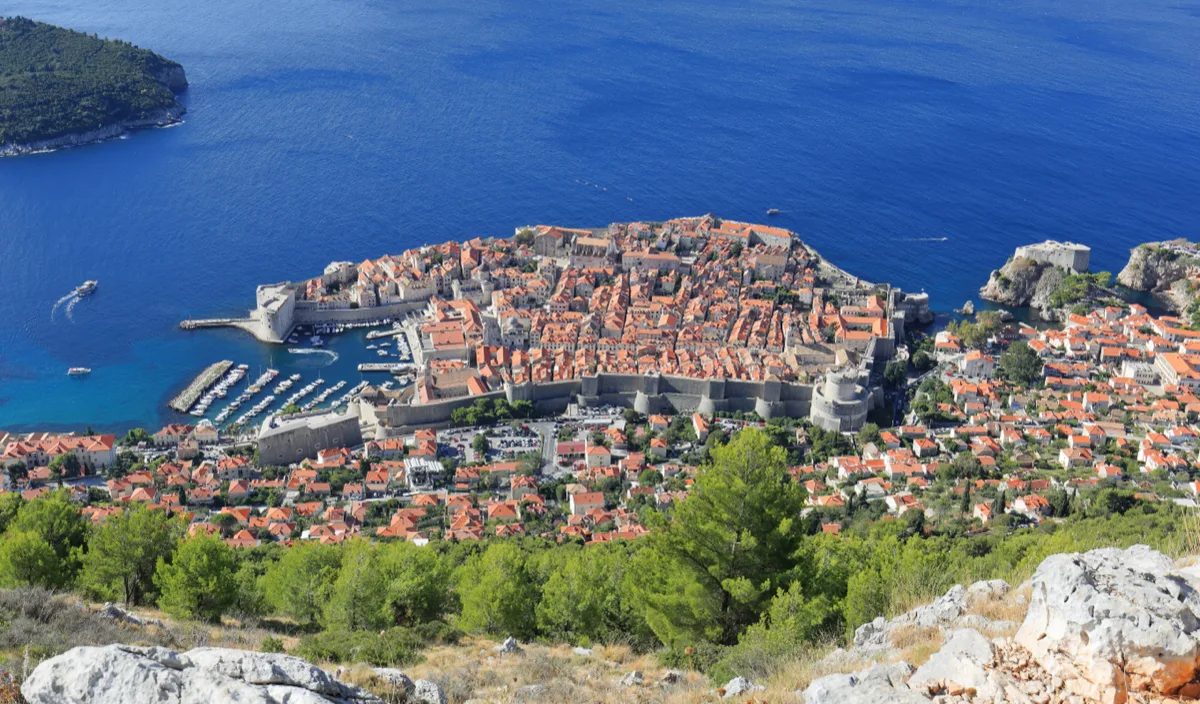
Mount Srđ is the 412-metre limestone ridge that stands directly above the Old Town’s northern walls — close enough that the summit cross is visible from Stradun, yet most visitors only ever meet it as a cable-car platform and a fifteen-minute photo stop. That undersells it badly. The summit is just the front edge of a broad karst plateau several kilometres deep, threaded with gravel tracks, dry-stone walls and old military roads. It is the best viewpoint on this stretch of the Adriatic, one of the most fought-over pieces of ground in Croatia’s modern history, and — the part we care about professionally — superb buggy country. It is also where our tours begin: every self-drive departure leaves from the upper cable-car station, next to the Panorama restaurant.
What exactly is Mount Srđ?
Srđ is the coastal ridge that separates the city from its limestone hinterland. Tradition holds that its slopes were once covered in holm-oak woodland — dubrava in the local tongue — and that the forest gave the settlement below its name. Today the ridge is mostly bare rock and low macchia scrub, which is exactly why the views run uninterrupted in every direction. Two structures define the summit: the squat fortress of Fort Imperial, built under Napoleon between 1806 and 1812, and the great stone cross facing the sea. Between them sits the cable-car top station — our meeting point — and from it the plateau tracks run east towards Bosanka village and the open karst beyond.
How do you get to the top of Srđ?
Three ways up — and one way to see everything once you’re there:
- Cable car. The original line opened in 1969 and ran until it was destroyed in the 1991–92 siege; the rebuilt system reopened in 2010 and makes the climb in 5–10 minutes. Step out of the top station and you are standing at our meeting point. Timetables and seasonal hours are published by the local tourist board.
- The Srđ road. A narrow paved road that switchbacks up the inland flank of the ridge. Taxis and ride-hailing apps know it, and it is driveable in an ordinary car, though parking at the top is scarce on busy days.
- On foot. A zig-zag hiking path climbs from the base of the ridge past the Way of the Cross stations. Reckon on about an hour up in good shoes, and carry water — there is no shade worth the name.
- Then, by buggy. The summit terrace is one viewpoint; the plateau behind it holds a dozen more. Our guided self-drive departures leave from beside the top station every 30 minutes and cover in half an hour of driving what a walker couldn’t reach in a day.
What is the story of the summit cross?
A monumental stone cross was raised on the summit in 1935 and stood for over half a century as the city’s most visible landmark after the walls themselves. During the siege of 1991–92 the ridge came under sustained shelling and the cross was destroyed along with almost everything else on the summit. The cross standing today is its post-war replacement, rebuilt on the same spot — and the shrapnel scars still visible on the fort a few metres away make the “before” easy to imagine. The story takes five minutes to tell and tends to change how people look at the view.
What can you see from the plateau?
On a clear day, an enormous sweep of coast. Directly below lies the UNESCO-listed Old City — from 412 metres you read its street plan like a map, Stradun cutting a pale line through the roof tiles. Offshore sits Lokrum, green and flat-topped, and beyond it the Elaphiti islands — Koločep, Lopud and Šipan — trail away to the north-west. Turn inland and the scenery flips entirely: grey karst ranges run unbroken to the hills of the Bosnian border, with barely a building in sight. That contrast — postcard coast on one side, empty stone country on the other — is the plateau’s party trick, and it is why film crews keep coming back. We cover the Game of Thrones angle in our filming-locations guide.
Why does the plateau suit buggies so well?
Because it is a natural trail network. The top of Srđ is not a peak but a shelf: several kilometres of rolling karst laced with gravel service tracks, shepherd paths and dry-stone walls, with viewpoint spurs breaking off towards the sea every few hundred metres. A side-by-side buggy covers it the way nothing else can — quick enough to link several viewpoints in one ride, narrow enough for tracks a car could never take, and open to the air the whole time. Our machines are brand-new, fully automatic Can-Am Mavericks in 2- and 4-seat versions, so no off-road experience is needed: if you can drive a car, you can drive one. You take the wheel behind a lead guide; helmets and a full briefing are included. Drivers need a valid licence and must be 18 — part of the route uses a public road — and kids from five ride as passengers. The fine print is in our licence guide.
How do our tours use Mount Srđ?
The mountain is our home ground, and every tour touches it:
- Self-Drive Buggy Tour — 30 minutes of driving from the upper cable-car station, departures every half hour from 09:00 to 18:30. You drive, the guide leads, and the convoy stops at panoramic viewpoints above the Old Town and the Adriatic. From €40 per adult (€50 riding solo, children 5–11 €20).
- 2-Hour Private Chauffeur Tour — €290 per vehicle for up to 3 guests. Your guide drives from your hotel through Gruž, Lapad and Babin Kuk, finishing with the Srđ panorama.
- 3-Hour Private Tour — €330 per vehicle. Two hours chauffeured, then 30 minutes of self-drive to finish, ending up here at the cable-car station — ride the cabin back down to the Old Town.
- Sunset departures — the same self-drive at the day’s last slots, when the light on the ridge goes long; in spring and autumn the sun actually sets while you’re up here.
The full breakdown lives on our prices page. If you want more background before you ride, our complete guide to Mount Srđ goes deeper on the history.
When is the best time to be on the ridge?
The season runs March to November, daily from 09:00 to 19:00, with self-drive departures every 30 minutes. In spring the macchia flowers and the plateau is at its greenest; July and August bring real heat, so the first morning slots and the 17:00–18:30 golden-hour departures are the smart picks — the exposed karst radiates warmth by mid-afternoon. Autumn gives the clearest long views towards the Elaphiti. If your preferred half-hour is booked out, take the slot before it rather than after — mornings on the ridge start clearer, and the haze over the Adriatic builds through the afternoon. The one weather pattern to respect is the bura, the cold north-easterly that occasionally rakes the ridge; when it blows dangerously hard we rebook or refund rather than ride into it. Month-by-month detail is in our best-time guide.
Every departure meets at the upper cable-car station, next to the Panorama restaurant — ride the cable car up from the Old Town or take the Srđ road by car — and cancellation is free up to 48 hours before the start. Pick a departure and book your buggy; the mountain does the rest.