
Last updated: 2026-07-04
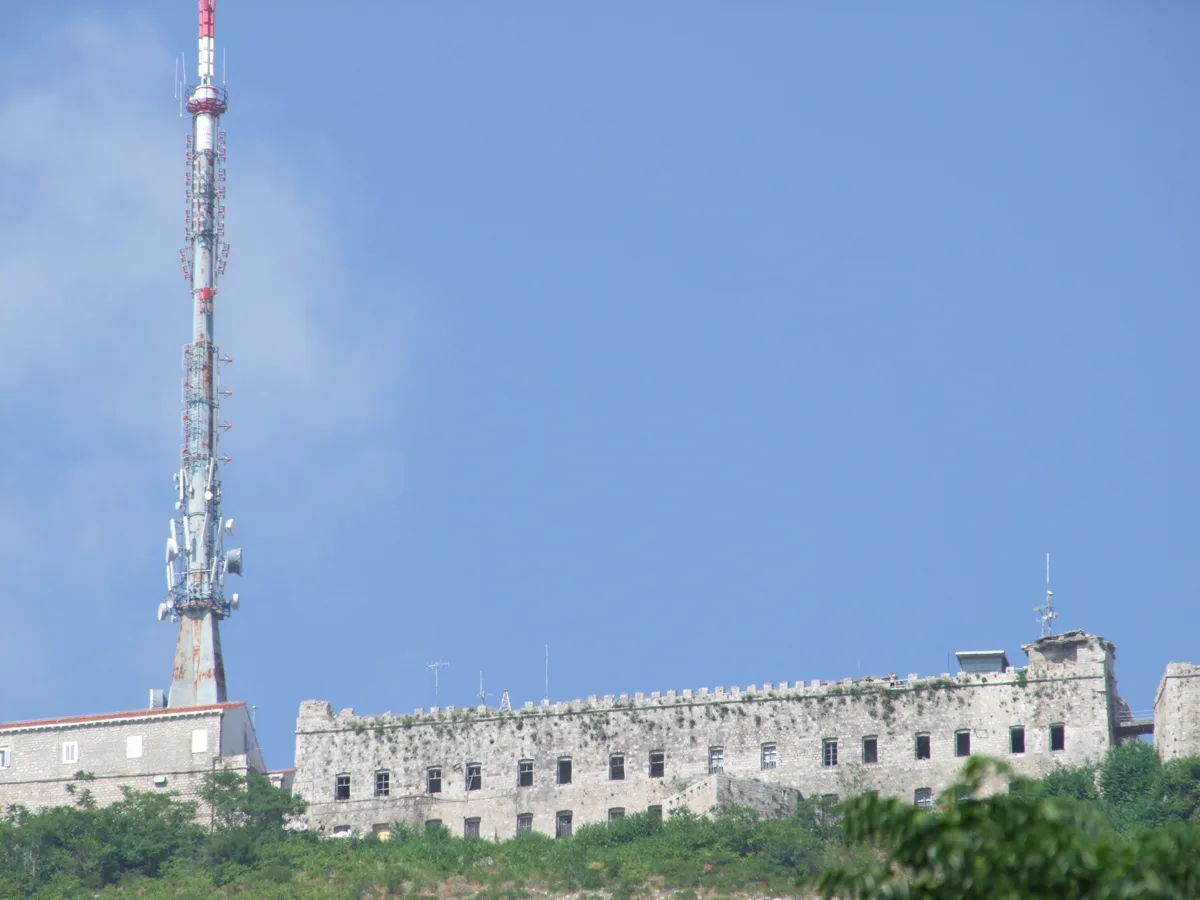
- Fort Imperial is a Napoleonic fortress on the 412 m summit of Srđ, built between 1806 and 1812, a short walk from the cable-car top station.
- During the 1991–92 Siege of Dubrovnik a small Croatian garrison held it against repeated assaults.
- The Homeland War Museum inside tells that story — allow 45–60 minutes.
- Our buggy tours meet at the cable-car station beside it and stop at the ridge viewpoints nearby.
Last updated:
Fort Imperial is the squat stone fortress on the 412-metre summit of Srđ, the ridge that rises directly behind the Old Town. It has had two lives. Napoleon’s engineers built it between 1806 and 1812 to control the heights above the harbour; a hundred and eighty years later it became the hinge of the city’s defence during the 1991–92 siege. Today its ground floor houses the Homeland War Museum, and the terrace above it carries one of the widest views on this stretch of the Adriatic.
I start tours beside its walls most days — the fort stands next to the cable-car top station, where our departures meet — and the viewpoints around it are a fixture of every route we drive. This guide covers both lives of the building, then the practical details: how to get up, what the museum holds, and how long to allow.
Why did Napoleon’s engineers build a fortress up here?
Because whoever holds the summit holds the city. When French troops occupied the Republic of Ragusa in 1806 — abolishing the thousand-year-old republic outright two years later — they understood immediately that the walled town below was indefensible without the ridge above it. Cannon on Srđ can reach every rooftop, every gate and every ship at anchor.
So between 1806 and 1812 they built Fort Impérial, named for the Emperor himself: a low, thick-walled artillery fort shaped to the summit plateau, positioned to command the land approaches from the east and the sea lanes toward Lokrum and the Elaphiti islands. The design logic is plain the moment you stand on the terrace — you can see everything, and everything can see you. Under the Austrian rule that followed, the fort stayed in military use through the nineteenth century, which is why it survived intact into the twentieth, when it was needed again.
What happened at Fort Imperial in 1991 and 1992?
It became the single most important defensive position in the Siege of Dubrovnik. In October 1991, during the Croatian War of Independence, the Yugoslav People’s Army attacked the region, cut the city off and shelled it from land and sea. On the summit, a small Croatian garrison — never more than a few dozen defenders at a time — held the old French fort while the fighting went on around and below them.
The heaviest day was 6 December 1991. Attacking forces reached the fort’s walls in a full assault; the garrison held the building through hours of close fighting, and with it held the high ground over the city. That same morning the Old Town itself — a UNESCO World Heritage Site, inscribed as the Old City of Dubrovnik — took some of the worst shelling of the whole siege, damage that international observers documented building by building. The siege was not fully lifted until 1992, when Croatian forces pushed the front line back from the ridge and the hinterland villages, Bosanka among them.
The fort still wears that winter. Walk around the outside and you can read the scars of shrapnel and bullet strikes in the stonework — nobody has polished the history away, and the building is more honest for it.
What is inside the Homeland War Museum?
A permanent exhibition on Dubrovnik in the Homeland War, displayed in the same rooms that were fought over. Expect photographs and film footage from the siege, maps of the positions on the ridge, weapons and shell fragments, uniforms, documents and the personal effects of defenders — a room-by-room account that runs from the outbreak of the attack in 1991 through the siege winter to the liberation of the surrounding area.
It is not a large museum, and that is part of its force: 45 to 60 minutes is enough for a careful visit. Captions are in Croatian and English. Tickets are sold at the door, and opening hours in the main season broadly track the cable car’s timetable — check current hours and prices with the Dubrovnik tourist board before you build a day around it, because they shift with the season.
One honest note on expectations. This is a war museum about events within living memory; local staff and guides — our own included — often have family stories from that winter. Take it at the pace it deserves.
How do you get up to Fort Imperial?
Four practical ways, in order of effort:
- Cable car — the lower station sits just above the Old Town walls; the ride to the top station takes a few minutes, and the fort is a two-minute walk from there.
- Road via Bosanka — a 15–20 minute drive from the city centre up the ridge road, with parking near the summit; the reliable route on days the wind stops the cable car.
- On foot up the Serpentine path — the zig-zag trail from town climbs about 400 vertical metres in roughly an hour to ninety minutes. There is almost no shade; carry water and skip it in the July–August midday heat.
- With us — our buggy tours meet at the upper cable-car station, two minutes from the fort, then cross the plateau past Bosanka village and stop at the viewpoints along the Srđ ridge, where the story of the siege is told on the ground where it happened. You drive your own buggy behind a lead guide; a category B licence is all you need, and drivers must be 18 or over.
There is a full practical page on the fortress itself at Fort Imperial if you want coordinates, context and what surrounds it on the summit.
How long should you allow, and when should you come?
Budget around two hours on the summit for the full programme: 45–60 minutes in the museum, a slow lap of the fort’s exterior to read the walls, and unhurried time at the viewpoints. Add the transport on each end — a few minutes by cable car, twenty by road, an honest half-day if you hike both ways.
Timing follows the light and the heat. Early morning gives you the museum almost to yourself and cool air for the walk; late afternoon gives photographers the warm side-light on the Old Town below; midday in July and August is the slot to avoid, since the summit plateau offers nearly no shade. On strong wind days check ahead — the bura can stop the cable car, in which case the road via Bosanka is the reliable way up.
Is the fort worth visiting if you skip the museum?
Yes — for the setting alone. The terrace and the ground around the fort give you the Old Town roofscape directly below, Lokrum just offshore, the Elaphiti islands strung out to the north-west and, on clear days, a horizon that runs far down the coast. Photographers get their best light early in the morning or in the last hour before sunset.
But the museum is what turns the view into understanding. From the terrace, the city looks untouchable — orange roofs, intact walls, calm sea. Inside, the photographs show you the same view with smoke over it. Holding both images at once is the point of coming up here, and it takes less than an hour.
If you would rather pair the fort with the plateau itself — driving the ridge trails behind a lead guide, with the siege story told on the ground where it happened — our self-drive buggy tour departs from the cable-car station beside the fort every 30 minutes, from €40 per adult. The full price list is on the prices page, and you can check dates and book online with free cancellation up to 48 hours before the tour.